

Pokeweed is probably not the first plant that comes to mind when someone thinks about creating a native garden.
In fact, for a long time, I didn’t think much about it at all.
American pokeweed (Phytolacca americana) is one of those plants that seems to simply appear. Birds eat the berries, deposit the seeds somewhere else, and before long another pokeweed is growing along a fence, beneath a tree, at the edge of a woodland, or somewhere in the garden where nobody planted it.
That is exactly how it began showing up around my yard.
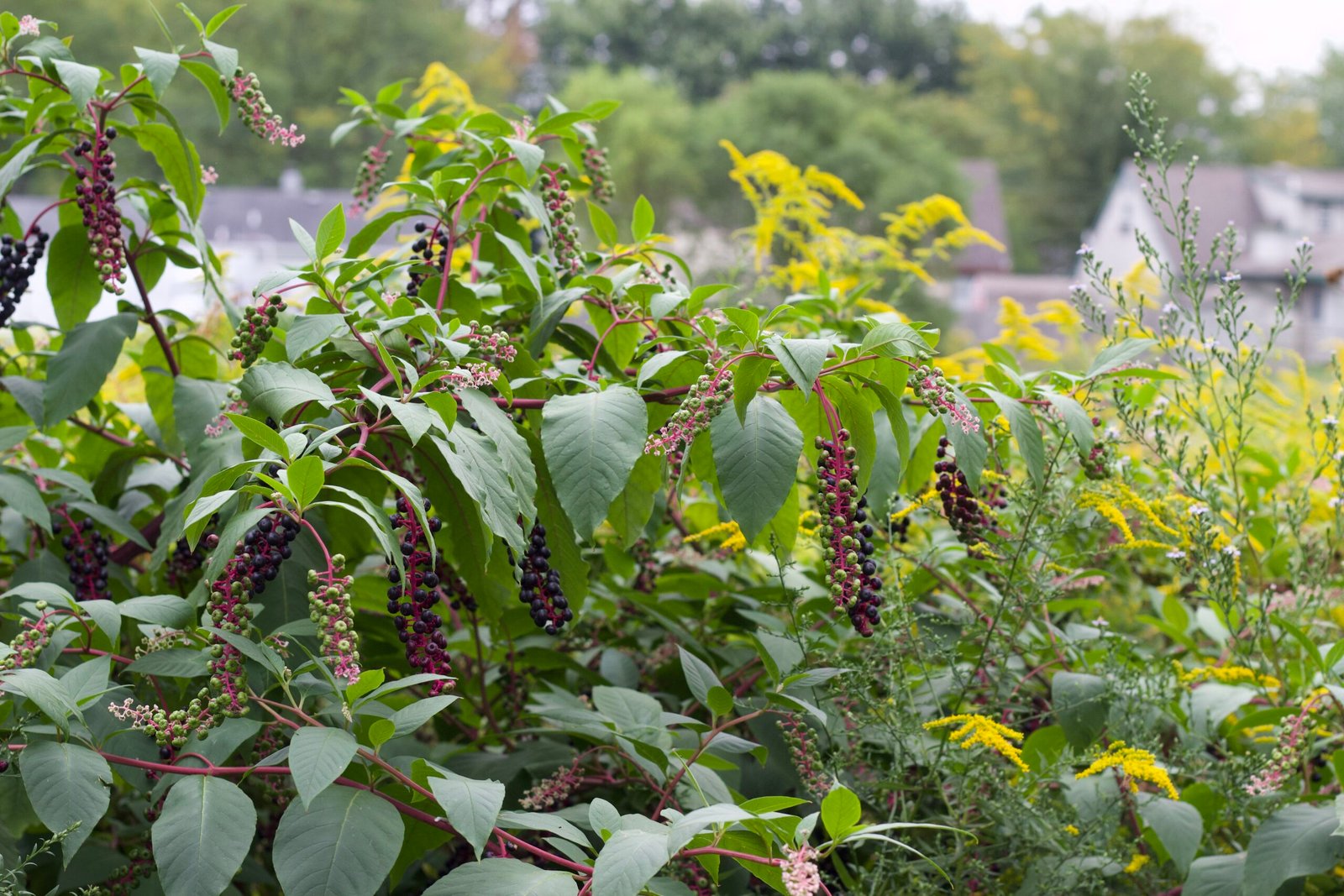
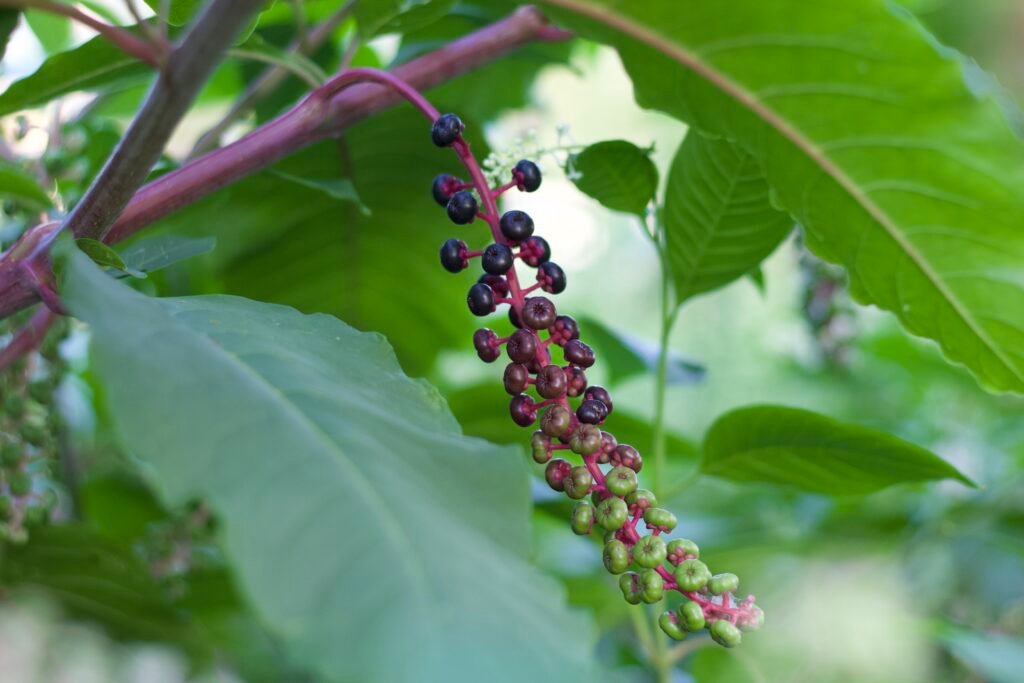
But the more time I’ve spent observing mature pokeweed, the more I’ve come to appreciate what this plant actually brings to a habitat. A fully developed plant can look almost like a small shrub, with large green leaves, branching reddish-purple stems, and clusters of dark purple berries hanging throughout the plant.
It isn’t a native plant I would recommend for every garden or every location. Given enough space, however, pokeweed can be an impressive structural plant while providing food and cover for wildlife.
Sometimes a “weed” is simply a plant we haven’t found the right place for yet.
Quick Facts
Scientific Name: Phytolacca americana
Common Name: American Pokeweed
Plant Family: Pokeweed Family (Phytolaccaceae)
Native Range: Much of eastern and central North America
Native Habitat:
- Woodland edges
- Open woodlands
- Thickets
- Clearings
- Fencerows
- Roadsides
- Disturbed areas
Bloom Time: July through September
Fruit: Late summer into fall
Height: Approximately 4–10 feet when mature
Spread: Commonly 3–5 feet or more on mature, heavily branched plants
Sun:
- Full sun
- Partial sun
- Tolerates considerable shade
Moisture: Average to moist soils; adaptable once established
Soil: Adaptable to a variety of soils, particularly rich or disturbed soils.
Why I Grow It
Pokeweed wasn’t really a plant I decided to grow. It decided to grow here.
Young plants occasionally appear throughout my yard, most likely after birds have eaten berries and deposited the seeds somewhere else. For a while, I mostly viewed them as volunteers that I could either leave or pull depending on where they appeared.
Then I watched one mature.
On the other side of my fence, along a thicket, I had a pokeweed that was at least seven feet tall. Instead of looking like the smaller weeds I had become accustomed to seeing, this plant had developed into something that almost resembled a shrub.
The stems branched outward in every direction. The reddish-purple color of those stems contrasted beautifully against the large green leaves, while clusters of dark purple berries hung throughout the plant.
It completely changed how I looked at pokeweed.
This wasn’t simply something growing along the fence anymore. It had architecture, texture, color, and movement while simultaneously providing habitat.
That combination is what made me start appreciating it.
Wildlife Value
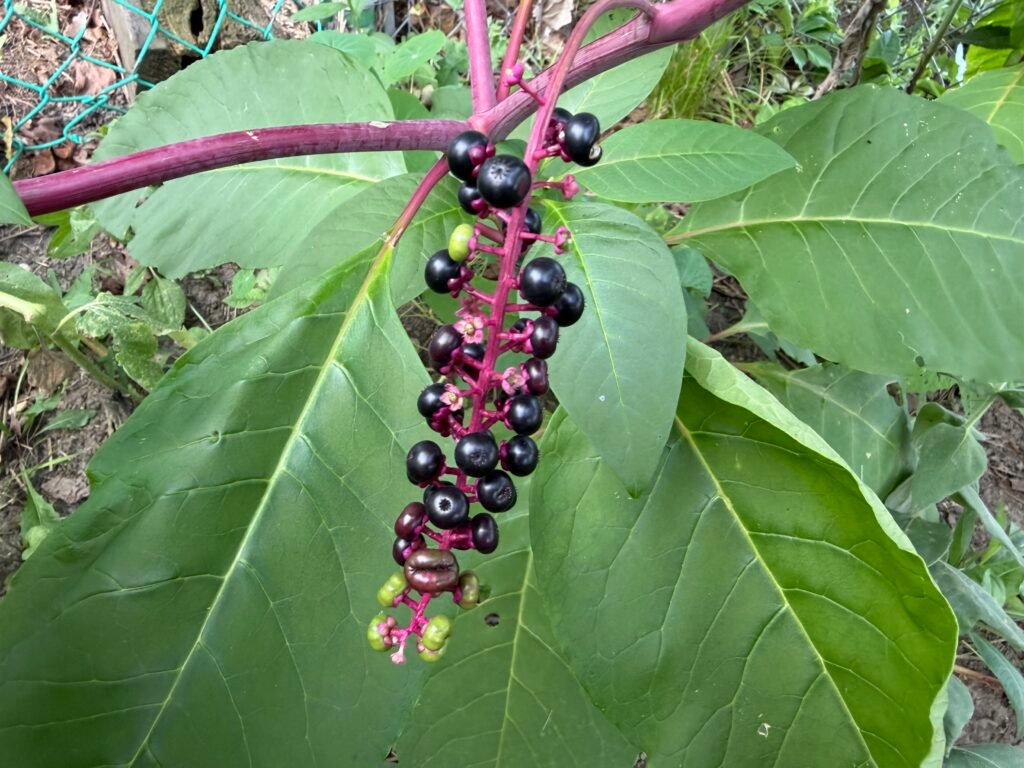
The berries are probably pokeweed’s most obvious contribution to a backyard habitat.
Numerous birds eat the dark purple fruits, and those birds are also one of the primary ways pokeweed spreads across the landscape. A bird can feed on the berries, move somewhere else to perch, and effectively plant the next generation.
That can occasionally be frustrating for a gardener, but ecologically it is a great example of the relationships that exist between plants and wildlife.
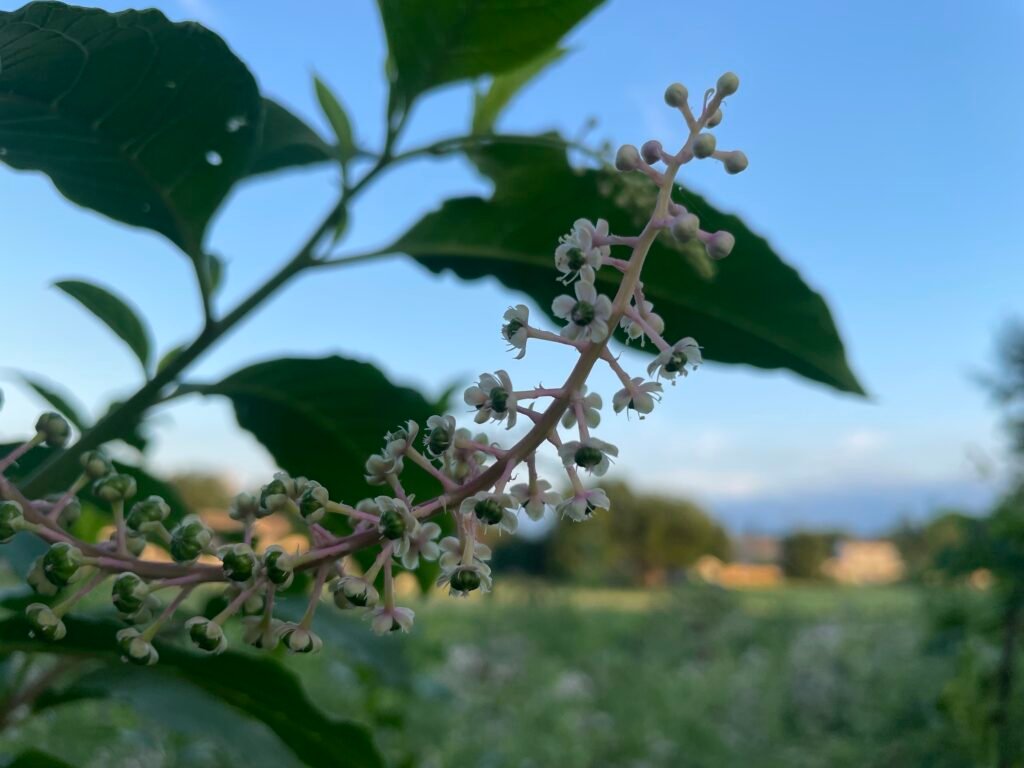
Pokeweed flowers also attract a variety of insects. The small flowers aren’t nearly as noticeable as something like mountain mint or coneflower, but they can be visited by small bees, hoverflies, wasps, and other flies.
And as the plant matures, its value becomes about more than flowers and berries.
A large pokeweed creates physical structure.
Its broad leaves and heavily branched growth create cover and perching opportunities within a planting. By late summer, a mature plant can occupy several feet of vertical and horizontal space, essentially creating another layer within the habitat.
That is something I have increasingly come to appreciate in native gardens. Wildlife doesn’t experience a garden as a collection of individual flowers. It experiences layers, shelter, food, openings, stems, leaves, branches, and places to move through or hide within.
Pokeweed contributes to several of those things at once.
Growing and Managing Pokeweed
Pokeweed is easy to grow.
In many cases, the bigger challenge is deciding where you want to allow it to grow.
Once established, pokeweed develops a substantial taproot and can return year after year. Mature plants can become very large, so this isn’t a species I would casually place in the middle of a small flower garden.
It also produces plenty of seed.
Birds spread those seeds throughout the landscape, which means new plants can appear well away from the original plant.
Interestingly, I haven’t found this particularly difficult to manage in my own yard.
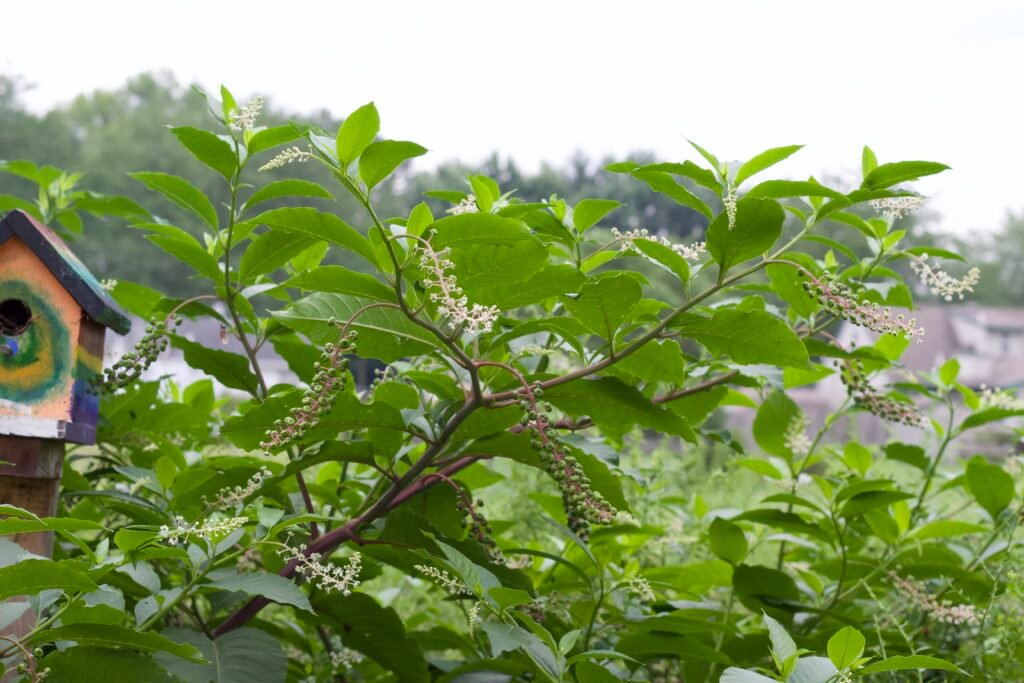
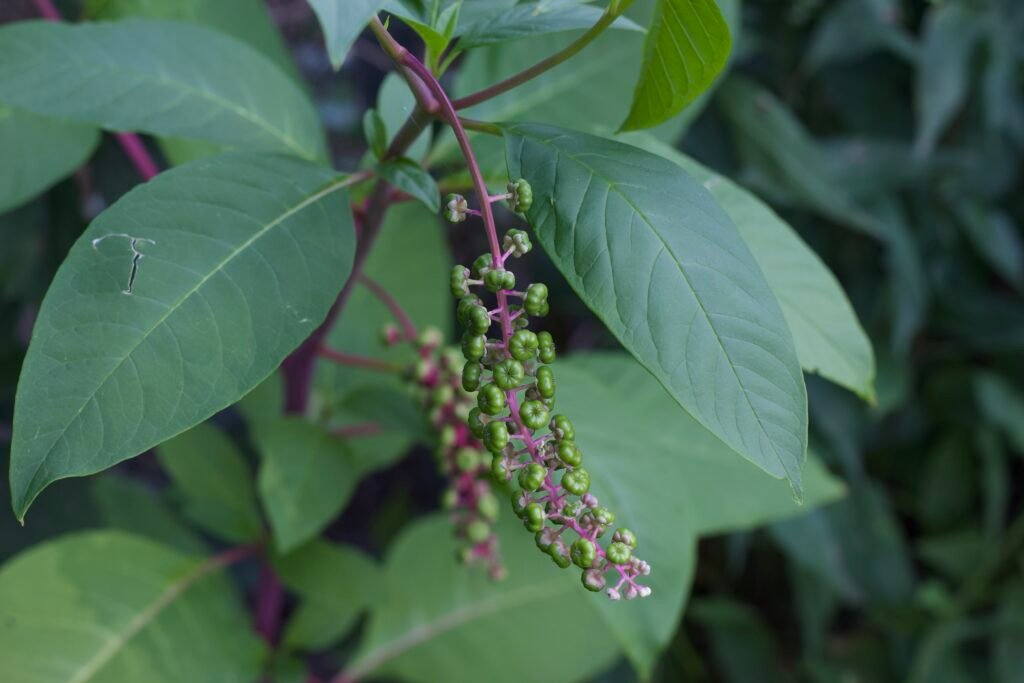
Young pokeweed is distinctive once you learn to recognize it. The smooth green growth eventually develops those characteristic reddish-purple stems, and unwanted young plants can simply be edited out when they appear.
That is an important distinction for me.
A plant can reproduce aggressively without necessarily being difficult to garden with. Pokeweed volunteers regularly, but I can decide which individuals fit into the habitat and remove the others while they’re still young.
The key is not allowing every volunteer to become a seven-foot mature plant with a large established root system.
Design Ideas
Pokeweed is not a plant I would recommend placing everywhere.
I probably wouldn’t use it along the front edge of a small garden or anywhere that requires a neat, compact appearance.
But give it the right setting and it can be spectacular.
Pokeweed fits naturally into:
- Woodland edges
- Large native gardens
- Wildlife gardens
- Fencerows
- Thickets
- Back borders
- Naturalized areas
- Transitional spaces between woodland and more open plantings
I especially like it as a background plant where its size becomes an advantage rather than a problem.
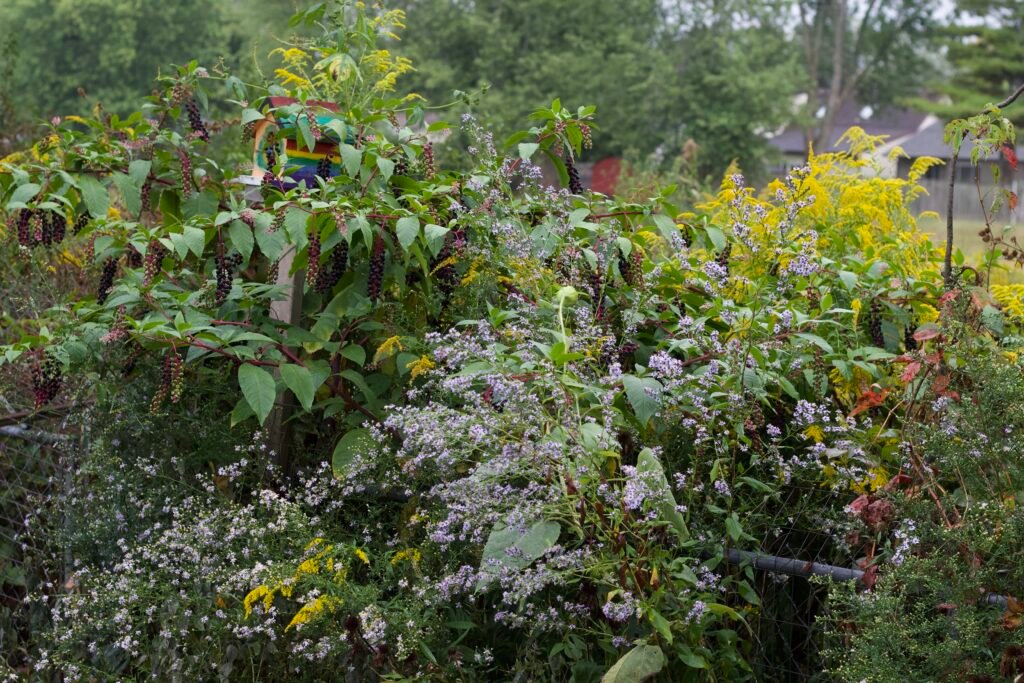
The large leaves create a completely different texture from grasses and fine-leaved perennials, while the reddish-purple stems and berries add color later in the season.
It could pair naturally with plants such as goldenrods, asters, ironweeds, woodland sunflowers, native grasses, and other species capable of holding their own around a large structural perennial.
Instead of treating pokeweed like a traditional garden flower, I think it makes more sense to treat it almost like a temporary shrub.
A Note About Pokeweed Toxicity
There is one important consideration with pokeweed.
All parts of the plant contain toxic compounds and should not be eaten raw. The root is considered the most toxic portion of the plant, while the leaves, stems, and berries also contain toxins.
There is a long history of people preparing very young pokeweed shoots as food using specific traditional preparation methods, but this isn’t something I recommend experimenting with.
For a backyard habitat, I simply treat pokeweed as a wildlife plant rather than an edible one.
This is also worth considering when deciding where to allow the plant to grow, particularly in spaces regularly used by young children or pets.
Birds, however, readily consume the berries and play an important role in dispersing the seeds.
Seeing the Same Plant in Different Habitats
One of the things that has made pokeweed particularly interesting to me is seeing how differently it can grow depending on its surroundings.
The mature plant near my yard grew with enough light and space to become enormous. It was at least seven feet tall, heavily branched, and almost shrub-like.
Recently, I visited a wooded property where pokeweed was growing throughout much shadier conditions.
It was the same species, but it didn’t present itself in quite the same way.
That is one of the things I’ve become increasingly interested in as I’ve spent more time studying natural plant communities.
A plant profile can tell us that something grows in “sun to partial shade,” but seeing the plant in those different situations tells you much more.
Light, moisture, competition, soil, and the surrounding plant community all influence what that individual plant eventually becomes.
Pokeweed is a great example.
Give it enough resources and room, and this supposedly ordinary weed can become one of the most visually dominant plants in the landscape.
My Experience
Pokeweed has become one of those plants that reminds me why observation matters.
Had I simply categorized it as a weed the first time it appeared in my yard, I probably would have continued pulling every plant I found.
Instead, I left some alone.
Eventually I got to see what a mature pokeweed actually looks like.
Now, when a seedling appears somewhere in my yard, my first thought isn’t automatically, “I need to pull that.”
I look at where it’s growing.
Does it have enough room?
Would its mature size work there?
Could that spot use another layer of structure?
If the answer is no, I pull it. If the answer is yes, sometimes I let it stay and see what happens.
That doesn’t mean pokeweed belongs in every native garden. It gets large, reproduces readily, and can become difficult to remove once its root system is established.
But in the right place, I think it deserves more appreciation than it usually receives.
A mature pokeweed can provide food, cover, structure, and some of the most interesting late-season color in the garden.
And perhaps most importantly, it taught me something.
Sometimes creating habitat isn’t about deciding exactly where every plant belongs.
Sometimes it’s about paying attention to what shows up, understanding what role it might play, and then deciding whether there is room for it.


