

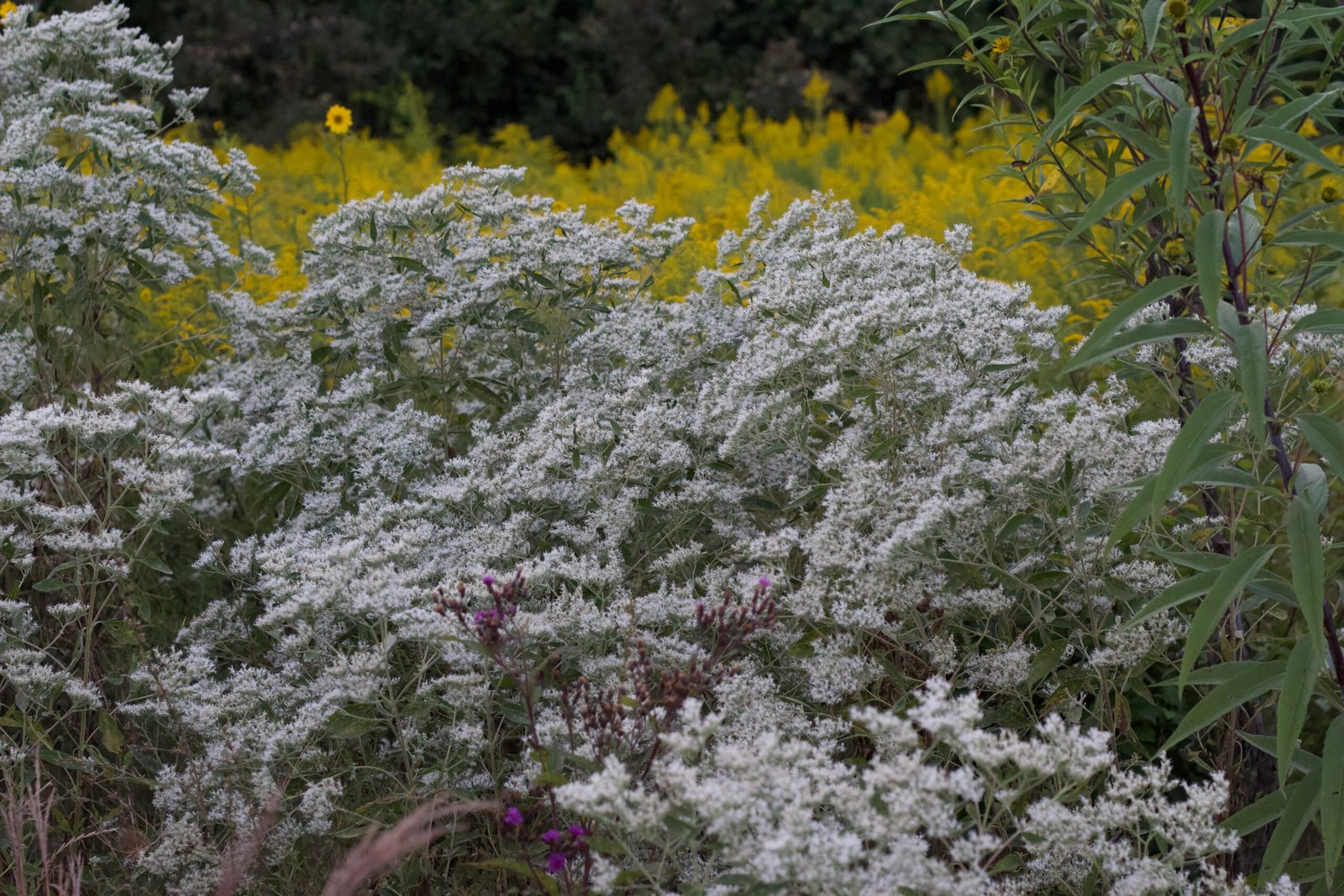
There are certain plants in my garden that seem to become gathering places.
Earlier in the summer, Virginia mountain mint is one of them. When it is in full bloom, I can stand beside it and watch an almost constant stream of bees, wasps, flies, beetles and other insects moving across the flowers.
As the mountain mint began to finish flowering this year, there was a short period when that activity seemed to slow down.
Then the late boneset opened.
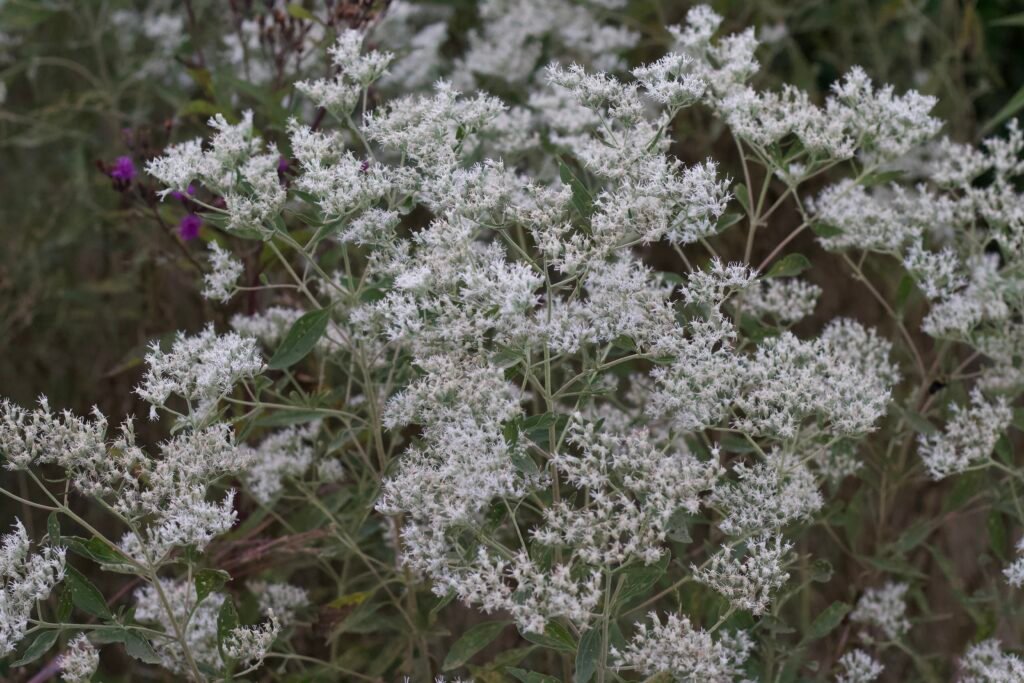
Late boneset (Eupatorium serotinum) has quickly become one of my favorite native plants for late-season pollinator activity. The large clusters of tiny white flowers don’t necessarily demand attention from across the garden, but the insects certainly seem to notice them.
Of all the native plants I’ve grown, Virginia mountain mint and late boneset have probably attracted the greatest diversity and amount of insect activity I’ve personally observed.
And late boneset provides that abundance at an especially important time—as summer begins giving way to fall.
Late Boneset Quick Facts
Scientific name: Eupatorium serotinum
Common names: Late boneset, late-flowering thoroughwort
Plant family: Asteraceae
Plant type: Native herbaceous perennial
Height: Commonly around 4–6 feet, but capable of growing taller under favorable conditions
Spread: Approximately 3–4 feet when mature, although established plants can form larger colonies over time
Bloom time: Late summer into fall, generally August through October
Light: Full sun to partial shade
Soil: Adaptable to several soil types
Moisture: Medium-wet to medium conditions; established plants can tolerate somewhat drier periods
Flower color: White
Wildlife value: Excellent late-season nectar and pollen source visited by bees, wasps, flies, butterflies, moths, beetles and other insects
Propagation: Seed and division; plants can also spread through rhizomes
Garden behavior: Large, branching perennial that can gradually form colonies when conditions are favorable
A Plant That Becomes Much Larger Than It Looks
Late boneset isn’t a plant I would squeeze into a small opening and expect it to stay there.
The plants growing in my garden are roughly five feet tall, but what has impressed me just as much is their width. Individual plants have developed into broad masses approximately three to four feet across.
That size gives late boneset an almost shrub-like presence by late summer.
My plants were originally grown from seed, and they are now growing in the heavy clay soil typical of my yard in northwest Ohio. I don’t amend the soil heavily or provide them with much special treatment.
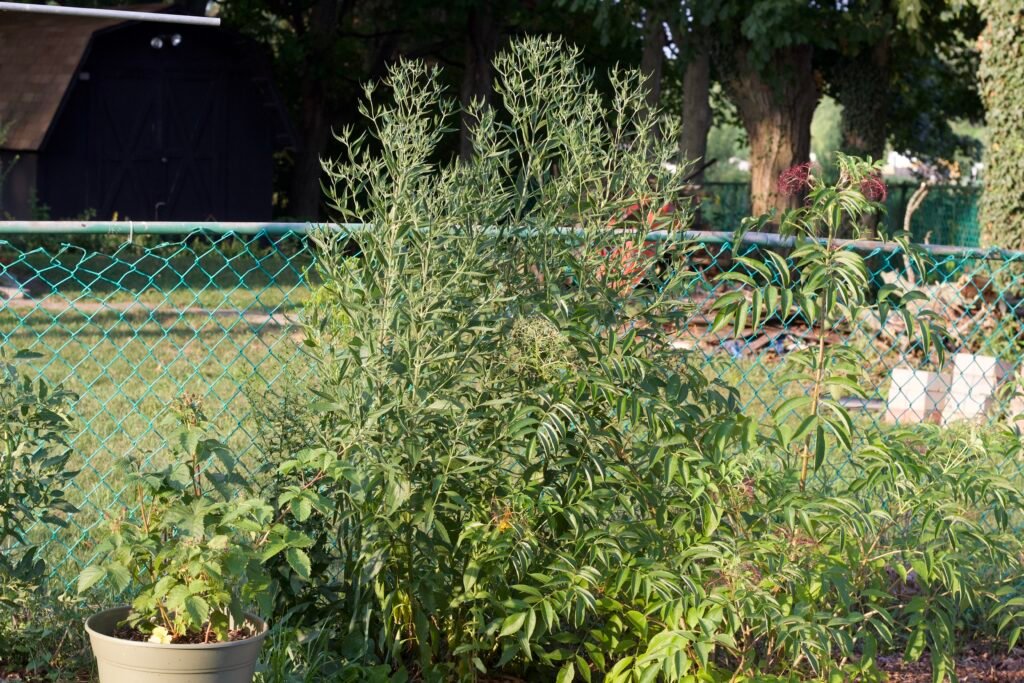
One receives somewhat more shade and moisture than the other, and I’ll occasionally give it additional water during dry periods. Both have nevertheless developed into substantial plants.
That’s also why I think published plant heights should be treated as guidelines rather than guarantees.
A plant’s eventual size is influenced by sunlight, moisture, soil, competition and the surrounding plant community. Late boneset may be described as a five-foot plant, but what it actually becomes in your garden depends on the conditions you give it.
Give it some room.
One of the Busiest Pollinator Plants in My Garden
This is where late boneset has really earned its place for me.
When the flowers open, they don’t produce a few large showy blooms. Instead, the plant becomes covered with broad clusters containing huge numbers of tiny white flowers.
And those flowers can become incredibly busy.
I’ve watched multiple kinds of wasps, bees, flies and other insects feeding on the same plant at the same time.
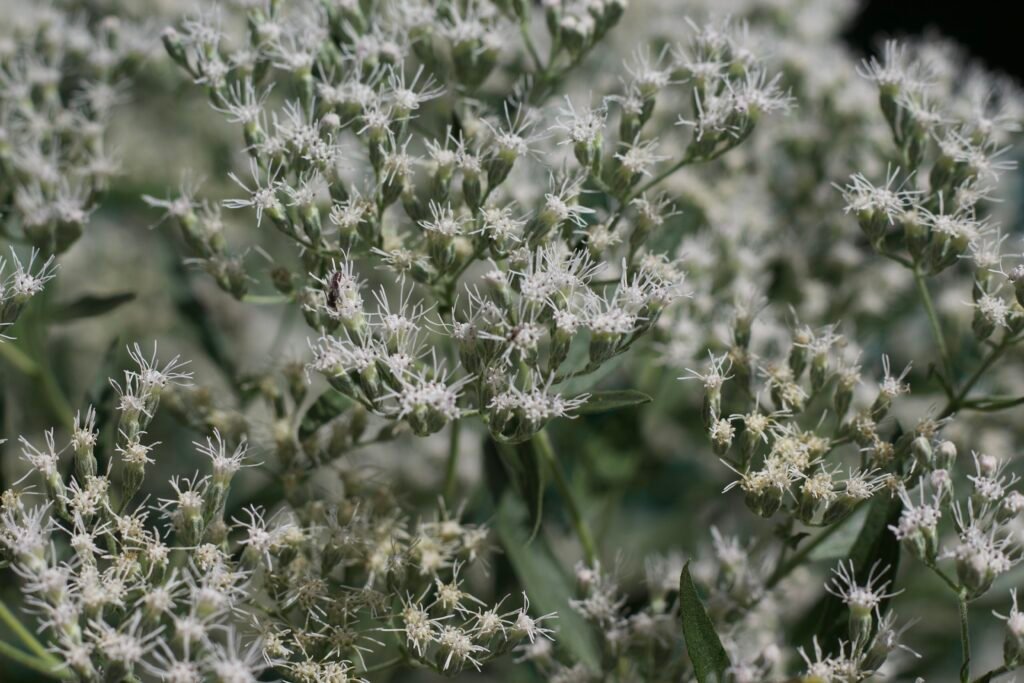
That diversity is one of the things I find most valuable.
When we talk about planting for pollinators, bees and butterflies tend to receive most of the attention. But a functioning backyard habitat includes an enormous variety of insects.
Wasps need nectar.
Flies visit flowers.
Beetles feed on pollen and nectar.
Moths and butterflies use flowers.
Predatory insects feeding as adults may later hunt other insects throughout the garden.
Late boneset doesn’t appear to be particularly selective about who gets invited.
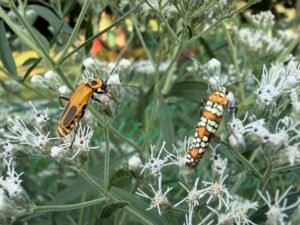
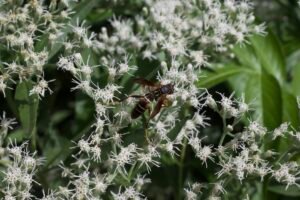
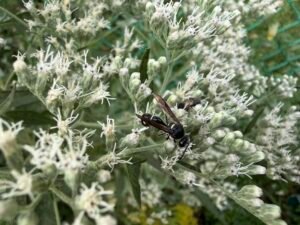
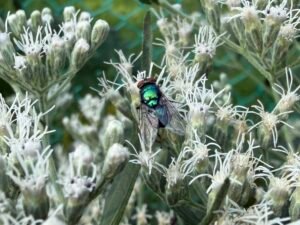
That becomes especially valuable because of when late boneset flowers.
By late summer, many earlier native plants are finishing. Late boneset helps carry floral resources into the period when asters and goldenrods begin taking over much of the landscape.
In my own garden, I watched Virginia mountain mint support enormous insect activity earlier in the season. As its flowering declined, there was a short lull before late boneset began blooming heavily.
Then the activity shifted.
That is exactly what I want from a habitat garden.
Not one perfect pollinator plant.
A sequence of plants providing resources from one part of the growing season into the next.
Late Boneset, Tall Boneset and Common Boneset
Late boneset isn’t the only native boneset you may encounter.
Three species I commonly pay attention to are late boneset (Eupatorium serotinum), tall boneset (Eupatorium altissimum) and common boneset (Eupatorium perfoliatum).
Their white flowers can look remarkably similar from a distance.
The leaves tell a much better story.
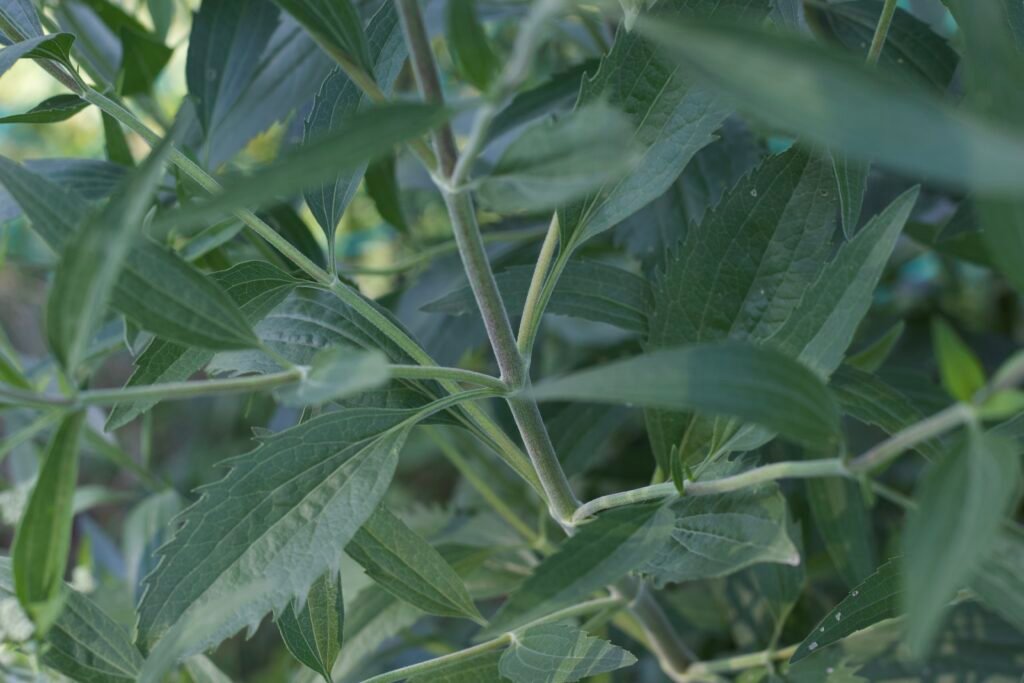
Late Boneset — Eupatorium serotinum
Late boneset has distinct petioles, or leaf stalks, connecting the leaf blade to the main stem.
On the plants in my garden, those petioles can be very noticeable. Once you learn to look at the point where the leaf meets the stem, late boneset becomes much easier to recognize.
Tall Boneset — Eupatorium altissimum
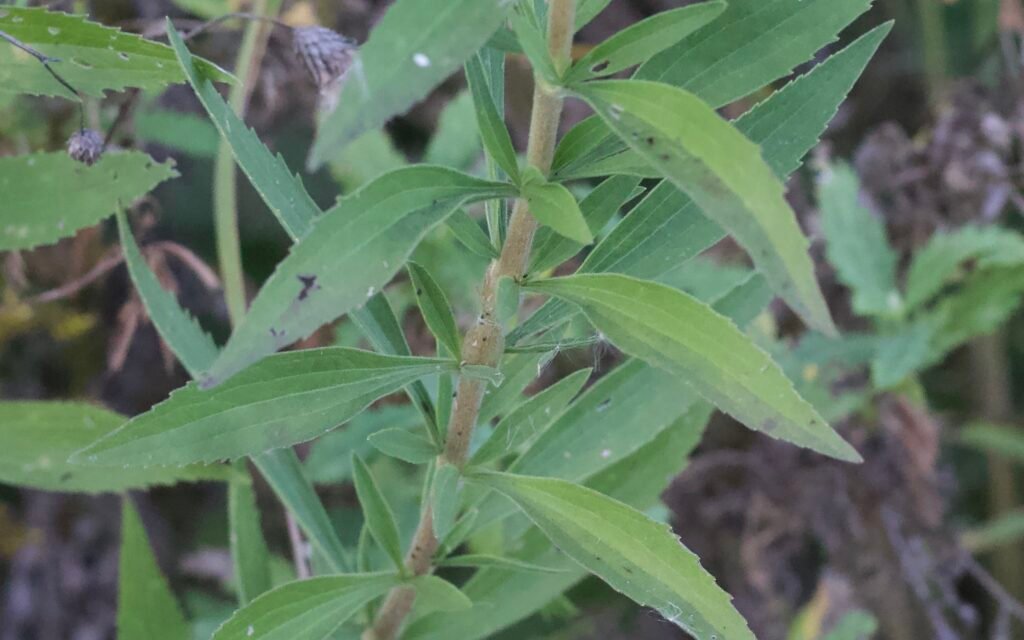
Tall boneset has narrower leaves that are sessile or nearly sessile, meaning there is little or no obvious petiole.
The midrib can therefore appear to continue almost directly from the stem into the leaf blade.
And despite being called tall boneset, it isn’t necessarily taller than late boneset.
That’s a good reminder of why I prefer using scientific names when identifying plants. Common names are useful, but they aren’t always particularly logical.
Common Boneset — Eupatorium perfoliatum
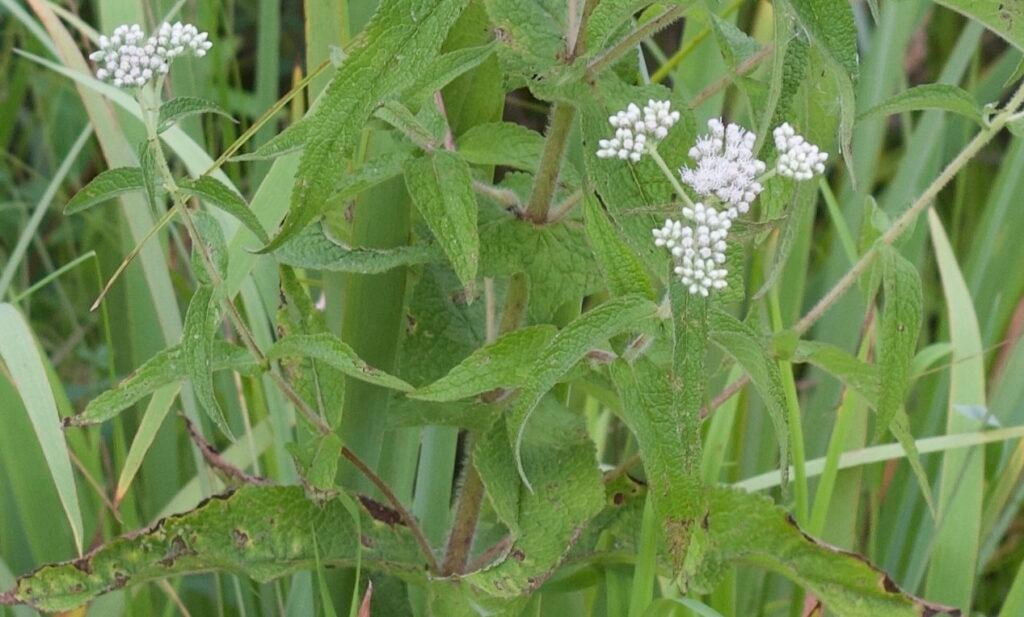
Common boneset may be the easiest of the three to recognize.
Its opposite leaves join around the stem, creating the appearance that the stem passes directly through the paired leaves.
Common boneset also tends toward wetter habitats than the other two species, making it particularly useful for rain gardens, swales, pond edges and other areas that regularly hold moisture.
If you’d like to understand why I use both common and scientific names when discussing plants, I wrote more about that here:
Common vs. Scientific Plant Names: Why They Matter
Choosing the Right Boneset for Your Garden
Rather than thinking of one boneset as universally better than another, I find it more useful to match the species to the conditions.
If I’m dealing with a consistently wetter location, common boneset would be high on my list.
For a somewhat drier site, tall boneset may be worth considering.
And for the conditions I encounter most often in residential landscapes, late boneset is an extremely useful middle ground.
It handles moisture well without requiring saturated soil, tolerates my heavy clay, grows in full sun or some partial shade, and provides a substantial amount of late-season flower.
I’ve also grown it long enough to know how it behaves in my own garden.
That matters to me when recommending plants.
Plant descriptions tell us what a species can do.
Growing it tells us much more about what it actually does.
Growing Late Boneset
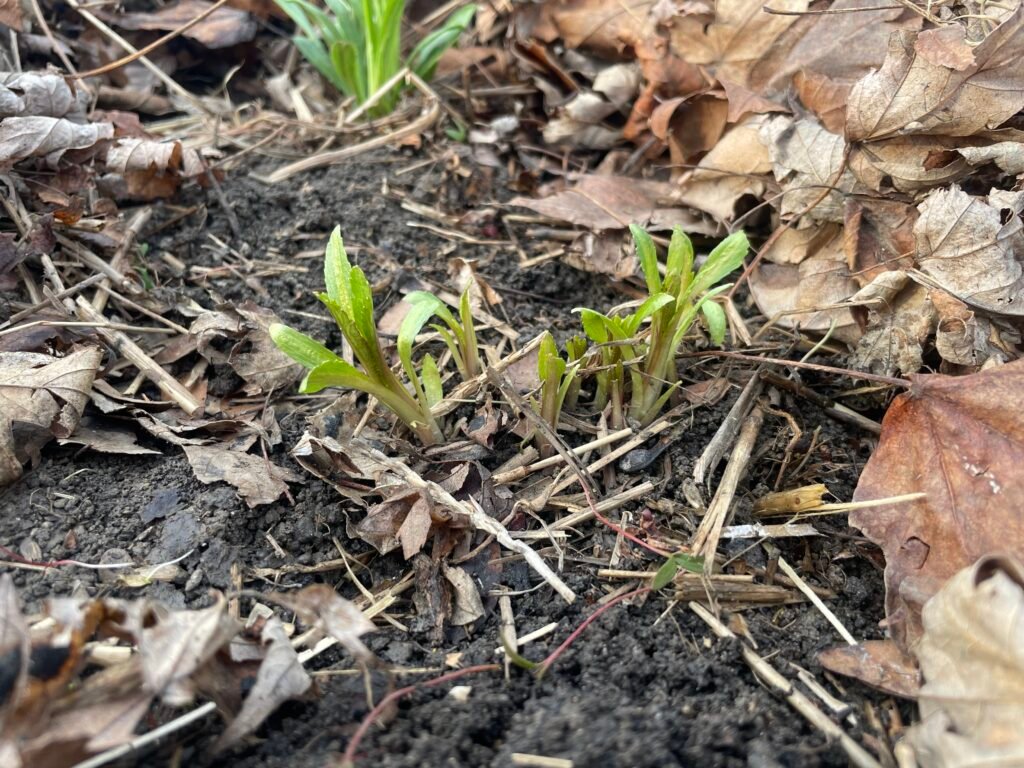
Late boneset is a perennial, so unlike an annual it establishes a permanent root system and returns each spring.
Established plants can become substantial, so I would give them several feet of room rather than planting them tightly against smaller species.
Full sun will generally produce the strongest flowering, although my experience has shown that late boneset can perform well with some shade. For the best blooms stick to full sun.
Moisture also influences its growth. In nature, late boneset is frequently associated with moist prairies, meadows, drainage areas, roadsides, thickets and other open habitats where moisture is readily available. However, it is adaptable enough to handle less consistently wet garden conditions.
Once established, mine have required very little attention. Well observation of coarse just not the “work” variety of attention.
That’s exactly the kind of plant I like.
Growing Late Boneset From Seed
Late boneset can be established from seed, although—as with many native perennials—patience is useful.
Seed should be sown shallowly rather than buried deeply. Outdoor fall or winter sowing is an easy way to expose native seed to natural winter conditions before spring germination.
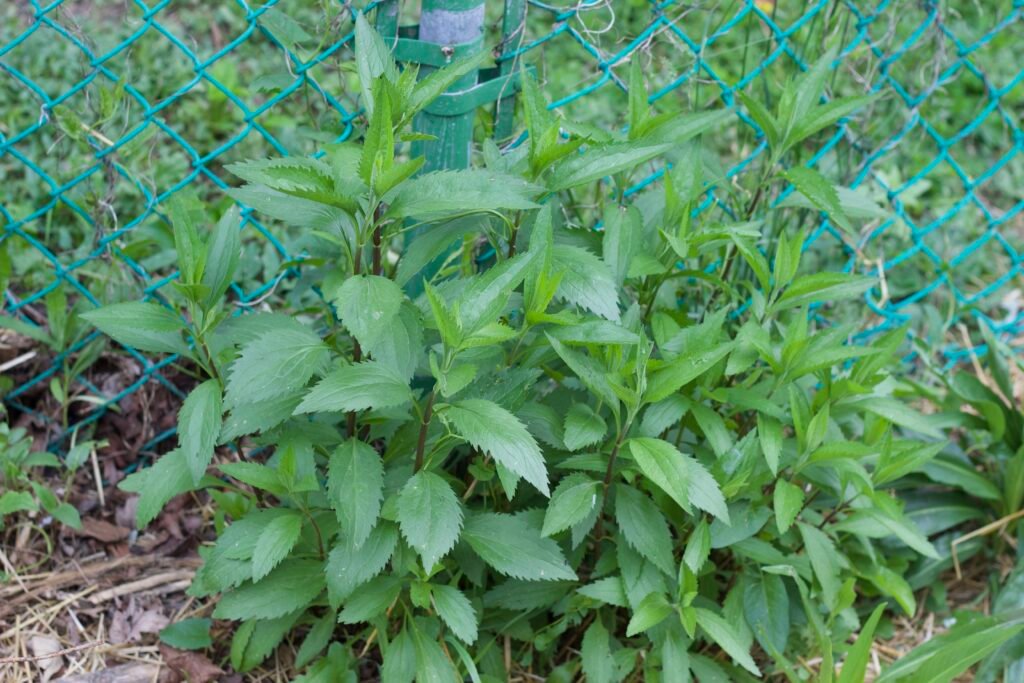
Once seedlings are established, their first season may be considerably less impressive than what the mature plant eventually becomes.
Just give the root system time to establish and you along with nature will be reaping the benefits very soon.
The enormous flowering plant you see throughout this blog, started as seed in the winter of 2024. By its second growing season, it had developed into a plant nearly five feet tall and several feet wide—a good reminder that something surprisingly small can become a substantial part of the garden remarkably quickly.
Using Late Boneset in a Backyard Habitat
Because of its eventual size, I see late boneset primarily as a structural plant rather than something sprinkled randomly along the front of a garden.
I’d use it toward the middle or back of a planting, depending on the surrounding species.
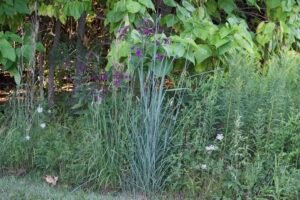
It works particularly well where its white flowers can mingle with the yellows, purples and blues that become increasingly common in late summer and early fall.
Goldenrods.
Instead of viewing those species as individual specimens, I like thinking about how their flowering periods overlap.
One begins blooming.
Another reaches its peak.
Another starts producing seed.
And another is just beginning.
Together they create a continuously changing plant community rather than a garden that reaches one peak and then disappears.
Why Late Boneset Has Earned a Place in My Garden
I grow a lot of native plants, and every year I learn something new simply by watching them.
Some surprise me with where they grow.
Some surprise me with how they spread.
And occasionally one surprises me with just how much life it attracts.
Late boneset has been one of those plants.
When I stand beside it during peak bloom, I’m not looking at one pollinator visiting one flower.
I’m looking at an entire feeding area.
Bees move between flowers.
Wasps work across the clusters.
Flies appear between them.
Other insects come and go.
And all of that activity is happening at a point in the season when summer is beginning to change into fall.
That’s ultimately why late boneset has become one of my favorite native plants.
The white flowers are beautiful.
The plant creates structure.
It handles the conditions in my yard remarkably well.
But more than anything else, it brings life into the garden.
And that’s what I’m trying to create.


