
Field observations recorded June 20, 2026.
Habitats Explored: Oak Savanna • Oak Woodland • Seasonal Wetlands • Sand Dunes • Prairie • Pond
Some places don’t reveal themselves all at once
Some parks greet you with sweeping overlooks, rushing water, or an abundance of wildlife. Lou Campbell State Nature Preserve takes a different approach. It invites you to slow your pace, quiet your expectations, and pay attention to the details that are easy to miss.
The preserve begins almost unnoticed. A small parking area gives way to a narrow opening surrounded by common milkweed. To one side, an oak savanna stretches into the distance. To the other, the woodland canopy closes around the trail. Nothing about the entrance suggests what lies ahead, and that’s part of its charm.
Before long, another resident of the preserve makes itself known. Mosquitoes seem to rise from every damp corner of the forest, making insect repellent less of a convenience and more of a necessity. In the distance, the steady hum of the Ohio Turnpike filters through the trees. While it’s impossible to ignore completely, the sound gradually fades into the background as the preserve begins revealing itself.
Despite the traffic and mosquitoes, an unmistakable stillness settles over the walk.
Not the stillness of an empty place, but the stillness of a landscape working patiently, quietly, and almost unnoticed.
Reading the Landscape
One of the things I enjoy most about exploring new habitats is learning to read the landscape before looking for wildlife. At Lou Campbell, the clues begin almost immediately.
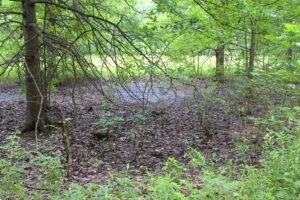
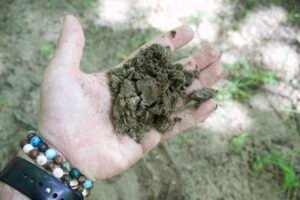
Just off the trail sits a dried vernal pool, its dark basin standing in contrast to the surrounding woodland. A few months earlier, this depression held enough water to support amphibians, aquatic insects, and countless other forms of life. By midsummer, the water has vanished, leaving behind little more than rich organic soil and a reminder that this forest changes dramatically with the seasons.
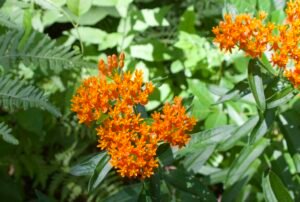
A short distance farther, the trail rises gently onto an ancient sand dune. The change is subtle, but the fine sand beneath my boots tells a different story than the damp woodland soil I had just crossed. Butterfly milkweed adds brilliant bursts of orange to the hillside, while wild lupine quietly hints at the unique plant community these sandy soils continue to support.
One of the most remarkable things about Lou Campbell isn’t any single habitat.
It’s the transitions between them.
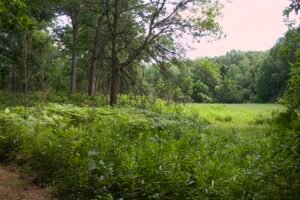
Oak savanna slowly blends into woodland. Woodland opens into prairie before giving way to broad patches of bracken fern. Seasonal wetlands appear and disappear with little warning, creating edges where one ecosystem quietly gives way to another. Nothing feels abrupt. Every habitat seems to ease naturally into the next.
It’s a reminder that nature rarely draws hard boundaries.
Time Written Across the Forest
Walking beneath the oak canopy, the pace of the preserve begins to slow even more.
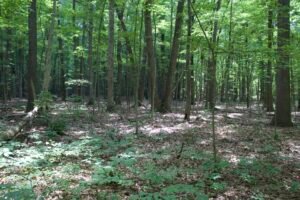
The forest floor is covered almost entirely in oak leaves. Their slow decomposition creates a rich layer of organic matter that muffles each step while quietly feeding the soil below. Curiosity gets the better of me, and I dig gently into the leaf litter with the small shovel I carry on these walks.
Beneath the surface lies dark, humus-rich soil woven together by countless fine roots. Even a few inches down, it becomes surprisingly difficult to dig. Although little vegetation occupies the forest floor, an unseen network of roots reminds me that much of the forest’s activity is happening below ground.
The trees tell similar stories.
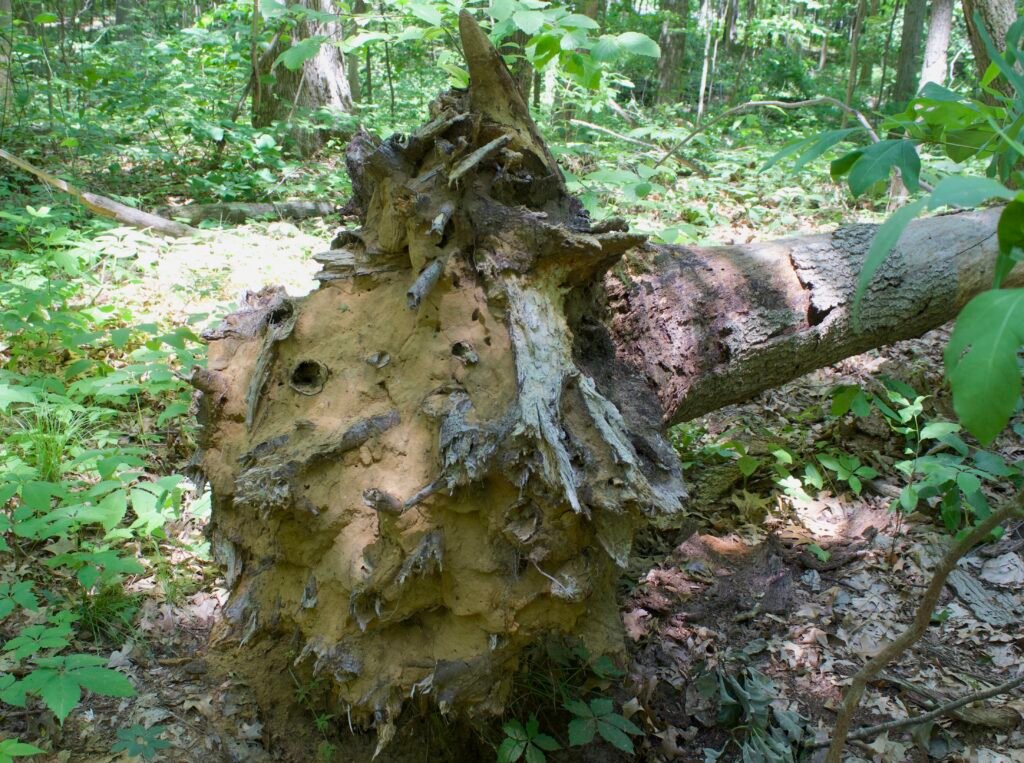
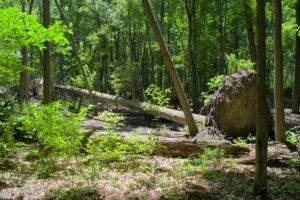
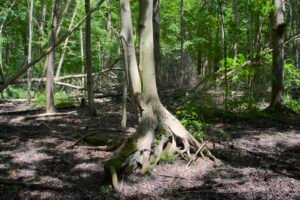
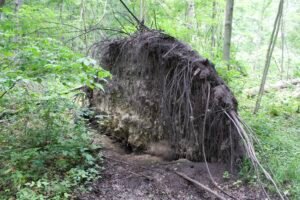
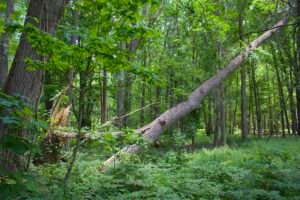
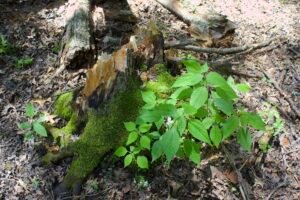
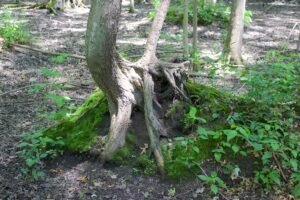
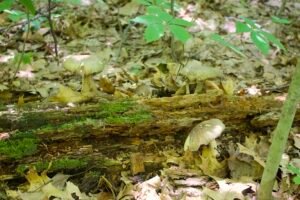
One uprooted tree exposes a massive root ball still coated in fine sand, revealing that the ancient dune extends farther beneath the woodland than I first realized. Nearby, exposed roots grip the soil like weathered hands, while fallen trunks slowly soften beneath mosses and fungi. Some trees have split with age and decay. Others remain suspended against neighboring trunks, becoming habitats long after their own lives have ended.
One section of the preserve stops me in my tracks.
Several towering trees have fallen in succession, opening a gap in the otherwise closed canopy. I couldn’t capture the entire scene with my camera, but standing among them was enough. The enormous root masses left behind still hold pockets of standing water, making me wonder if years of saturated soil slowly weakened the roots before one tree finally gave way.
Whatever happened, the story doesn’t end there.
Sunlight now pours through the opening, and a new race has already begun. Shrubs, grasses, saplings, and young trees are quietly competing to reclaim the space. Even in stillness, the forest is constantly rebuilding itself.
Looking Closer
One of the surprising things about this walk was how little wildlife I actually encountered.
Aside from a few squirrels rustling through the dry leaves, a Blue Jay calling from somewhere overhead, and a White-breasted Nuthatch working its way along a nearby trunk, the forest remained remarkably quiet. Had I judged the preserve by the amount of wildlife I saw, I might have missed what made it so memorable.
Instead, Lou Campbell encouraged me to look closer.
The soft cushion of moss slowly reclaiming a fallen log.
Tiny fungi quietly returning dead wood to the forest floor.
The deeply furrowed bark of mature oaks and the rugged texture of black cherry trees.
Fine sand slipping from an uprooted root ball.
The crisp blanket of oak leaves beneath my feet.
Every surface seemed to tell part of the preserve’s story.
Then a movement caught my eye.
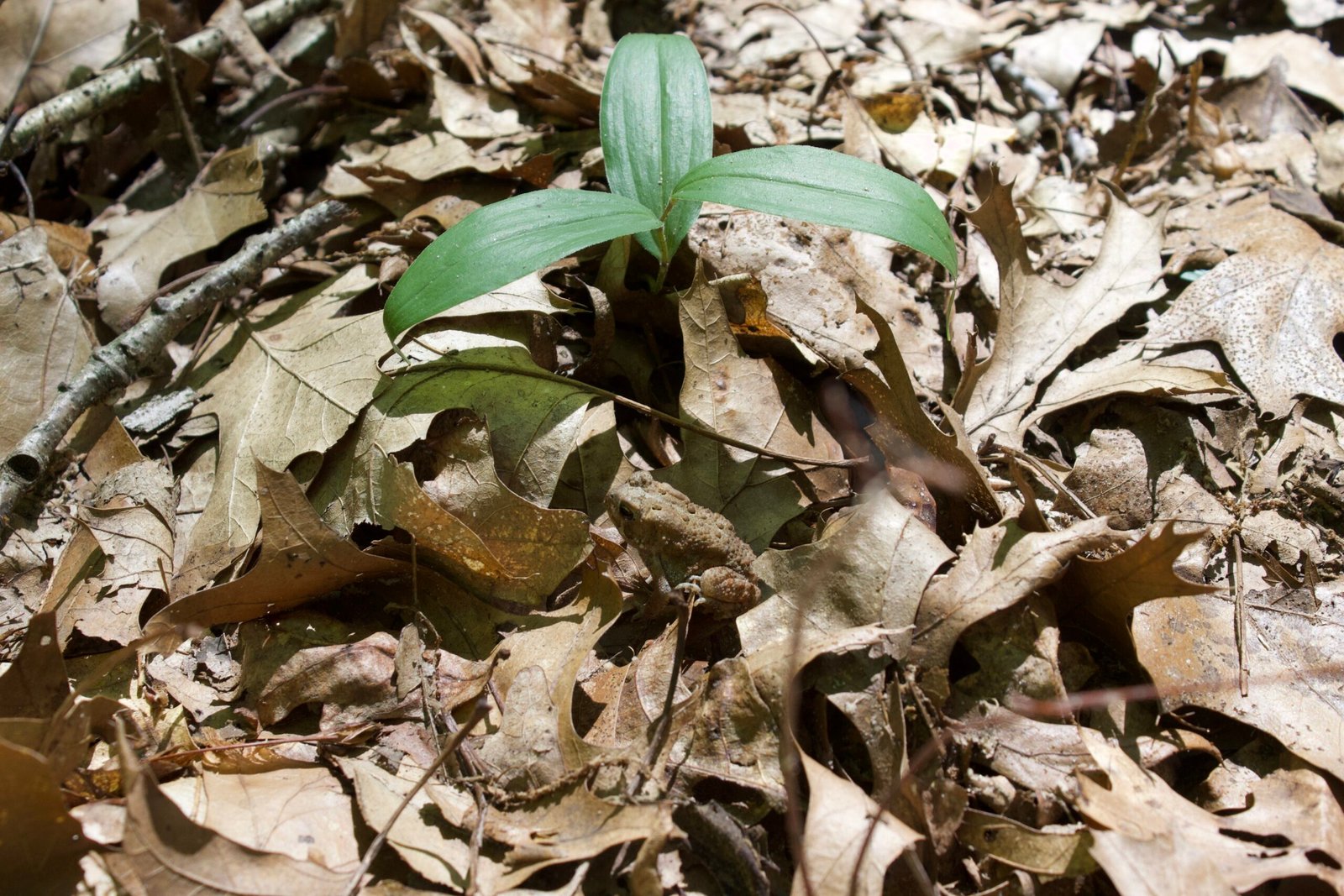
A small American toad hopped from the trail into the surrounding leaf litter. Once it landed, it didn’t continue running. Instead, it froze completely, trusting its camouflage. Within seconds it had disappeared, blending perfectly into the browns and grays of the forest floor. Had I not watched it land, I would have walked right past it.
Moments like that don’t happen because we move faster.
They happen because we slow down.
Small rewards
For much of the afternoon, the preserve is painted almost entirely in shades of green, brown, and gray.
That simplicity makes every splash of color feel intentional.
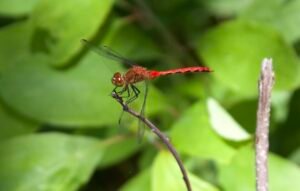
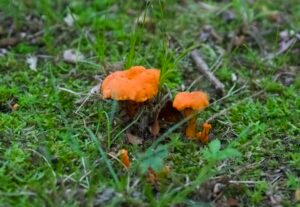
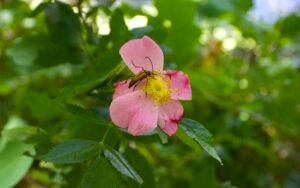
Brilliant orange butterfly milkweed brightens the sandy dune. A Ruby Meadowhawk dragonfly pauses long enough for a closer look before darting away. Tiny red chanterelle mushrooms glow against the woodland floor like scattered embers. Near the pond, a single swamp rose bloom supports a slender flower longhorn beetle, creating one of the few floral displays of the entire walk.
None of these moments dominate the landscape.
They simply reward those paying attention.
Water Never Really Leaves
Although visible water becomes less common as summer progresses, its influence never disappears.
Standing water lingers inside the cavities left behind by uprooted trees. Dark organic soils mark the edges of dried vernal pools. Even where the ground appears dry, moisture continues shaping the plant communities above it.
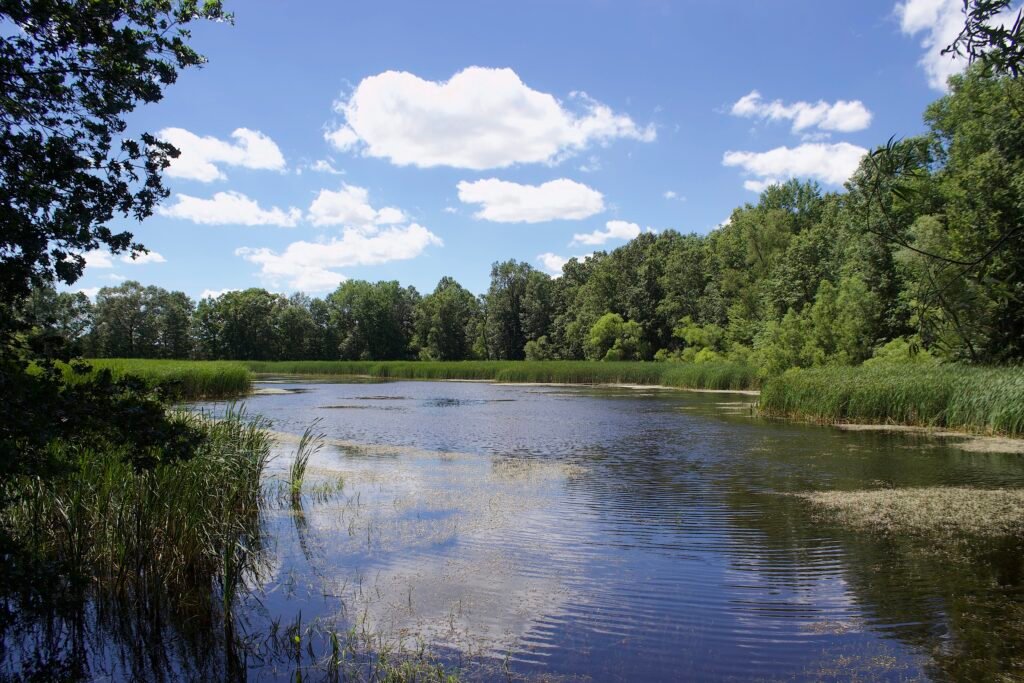
Eventually the trail reaches the preserve’s pond.
After nearly a mile and a half of quiet observation, it feels less like a destination and more like the final piece of the puzzle, the reward.
Black willows stretch their branches over the water’s edge while buttonbush, cattails, and swamp rose thrive along the shoreline. A nearby sign highlights the importance of this habitat for dragonflies and damselflies. Considering the steady population of mosquitoes throughout the preserve, it’s easy to appreciate how valuable this pond is within the larger ecosystem.
The pond doesn’t feel separate from the rest of the preserve.
It explains it.
Water has quietly shaped nearly every habitat encountered along the trail.
Bringing the Lesson Home
One of the biggest lessons I took away from Lou Campbell State Nature Preserve was that healthy ecosystems are built through connections.
Not just connections between plants and wildlife, but connections between habitats themselves.
A seasonal wetland transitions (typical of the Great Black Swamp area) into woodland.
Woodland gives way to prairie.
Ancient sand dunes support an entirely different plant community than the damp soils only a few yards away.
Those same principles can be applied in our own landscapes.
A rain garden bordering a native planting, a brush pile tucked beneath trees, or even a small pocket of shade can create valuable transition zones that wildlife quickly learns to use. Habitat isn’t simply about size. It’s about diversity, structure, and the relationships between different parts of the landscape.
Closing Reflection
Every Field Notes adventure has revealed something different.
Along the Maumee river, Side Cut Metropark and its hidden habitats that exist in places we often overlook.
At Swan Creek Metropark, it was a landscape still being shaped by water, erosion, and time.
Lou Campbell State Nature Preserve taught a quieter lesson.
Patience.
This isn’t a preserve that overwhelms visitors with dramatic overlooks or constant wildlife encounters. Instead, it invites you to notice the details that often go unseen—the fine sand beneath the forest floor, fungi quietly recycling fallen trees, seasonal wetlands that come and go, and a perfectly camouflaged toad trusting the protection of the leaf litter.
Before leaving, I found myself thinking about the person whose name this preserve honors.
Louis “Lou” Campbell was a naturalist, writer, and passionate advocate for the landscapes of northwest Ohio. Through his observations and writings, he helped others appreciate the remarkable ecosystems of the Oak Openings Region long before many of us had the opportunity to walk these same trails. It seems fitting that a preserve bearing his name continues to reward careful observation above all else.
Some places ask us to look.
Lou Campbell State Nature Preserve reminds us to notice.