
My backyard is about an eighth of an acre.
Technically, I don’t even own it.
I rent it from someone who purchased the property years ago. There are property lines, legal documents, and county records that determine exactly where one person’s land ends and another begins.
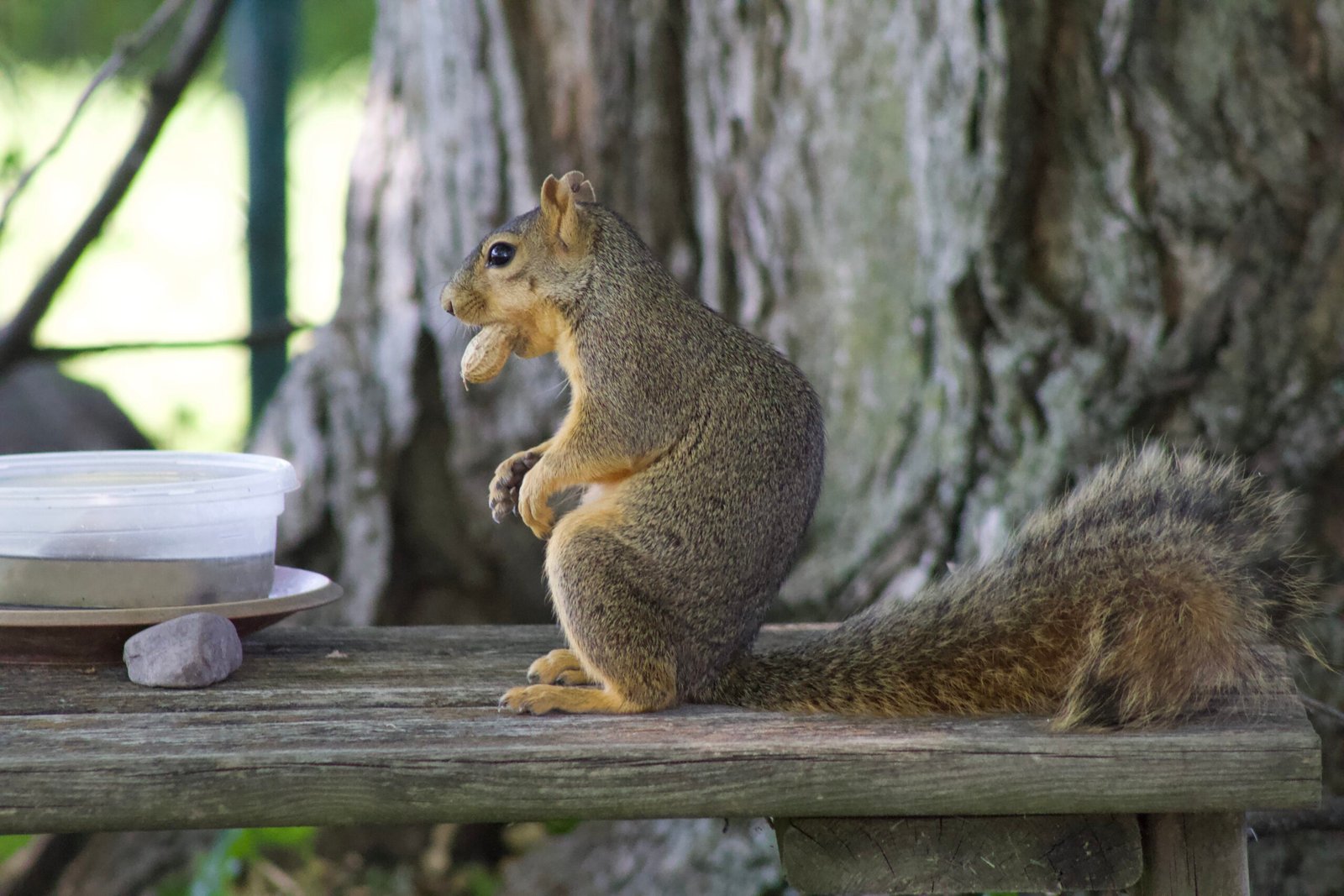
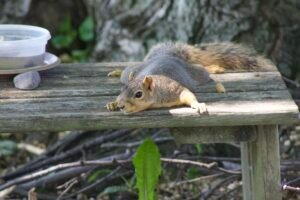
Maddie, the resident fox squirrel, doesn’t care about any of that.
As far as she’s concerned, the old maple tree, the mini bird pond, and every peanut that occasionally lands on the ground are part of her world.
And honestly, she’s not the only one.
A Neighborhood of Landowners
To human eyes, this is one small backyard.
To wildlife, it appears to be something very different.
Maddie patrols the maple tree and nearby food sources. She isn’t aggressive all the time, but she’s quick to remind other squirrels when they get too close to resources she values.
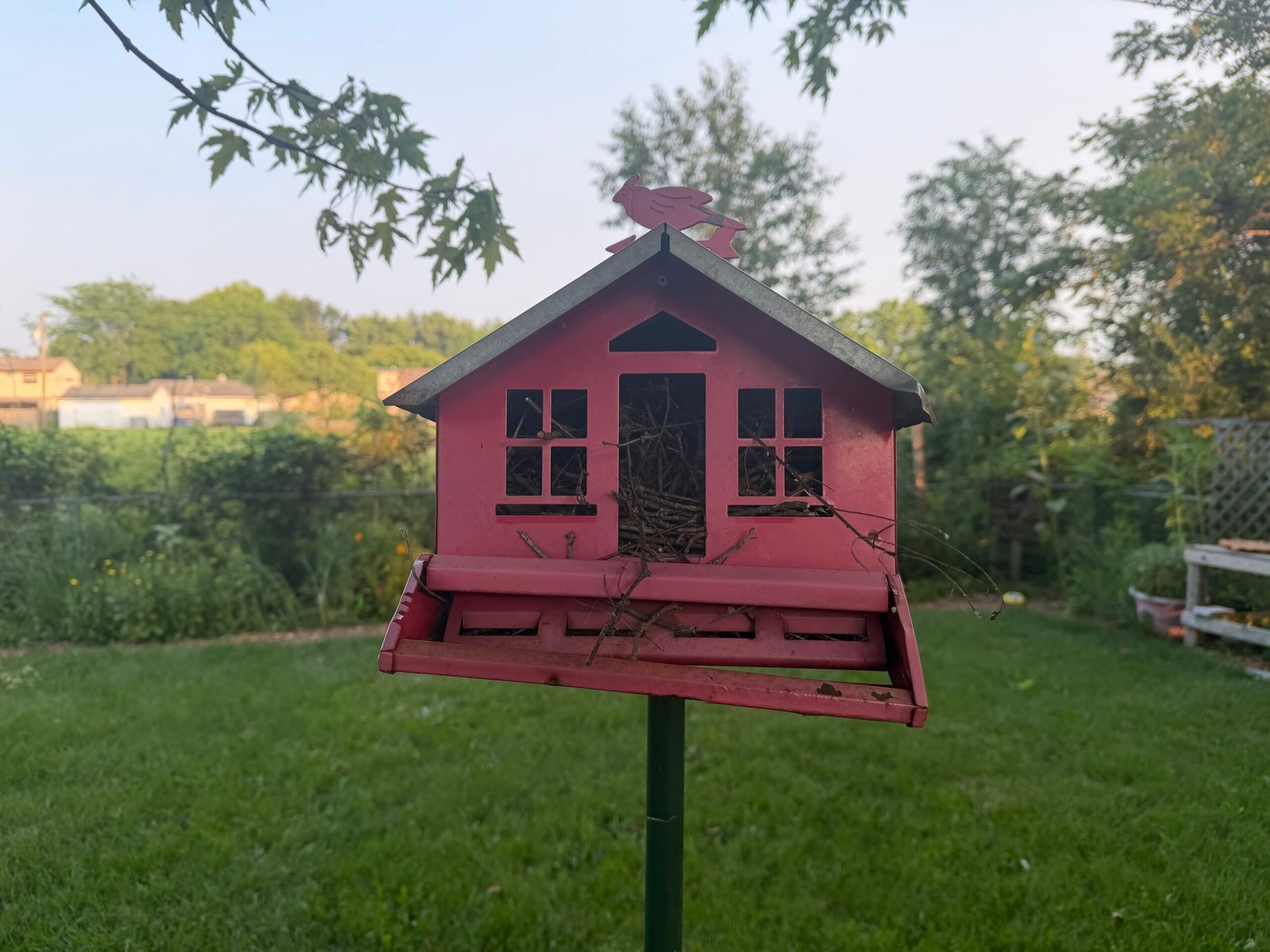
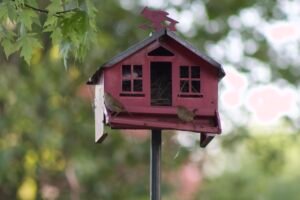
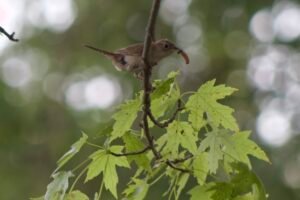
A pair of house wrens have claimed an old bird feeder house as a nesting site. They defend it with remarkable determination for such small birds.
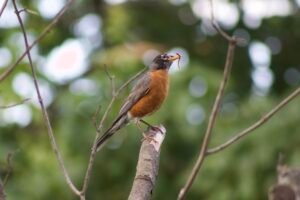
A robin spends much of the day perched near my water feature (about 10ft from her nest). Whenever another robin enters the area, a chase usually follows. Even squirrels attempting to climb the tree are sometimes met with protest flights and alarm calls.
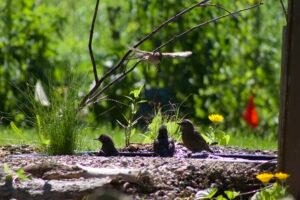
Nearby, house sparrows are raising young in a couple of birdhouses that were intended for other species. Their nestlings currently spend much of the day peeking out of the entrance, waiting for the next meal to arrive.
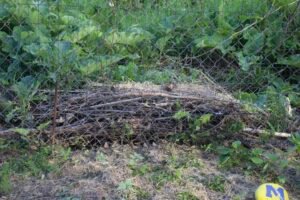
A pair of chipmunks dart through the brush and log piles along the fence line.
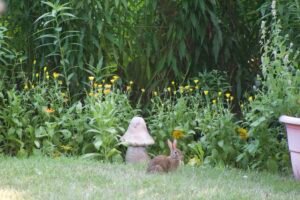
Rabbits emerge in the evening to browse clover and tender vegetation.
A groundhog moves along familiar paths between shelter and feeding areas.
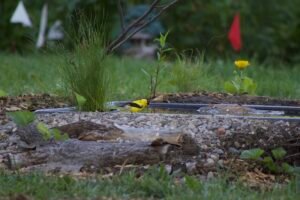
American goldfinches drift between flowers and seedheads throughout the summer.
Garter snakes slip between brush piles, occasionally emerging to bask in the sun.
And beneath nearly all of these interactions is an army of insects—pollinating flowers, feeding nestlings, recycling organic matter, and serving as food for countless other species.
Each species is using the same small piece of land, but none of them are experiencing it in the same way.
What I call a backyard, they experience as a network of feeding grounds, nesting sites, escape routes, shelter, and territory.
To me, it’s an eighth of an acre.
To them, it’s an entire world.
The Invisible Boundaries
What fascinates me most is that none of these animals recognize the property lines shown on a survey map.
They don’t know where my yard ends.
They don’t know where the neighbor’s begins.
Their boundaries are drawn differently.
In ecology, scientists often distinguish between two concepts: territories and home ranges.
A territory is an area actively defended from others. The robin protecting a nesting area is a good example. The wrens guarding their nest site are another.
A home range is different. It refers to an area an animal regularly uses for food, shelter, and movement but doesn’t necessarily defend.
Maddie doesn’t stop at the property line to check who owns the next yard. The rabbit probably does as well. The groundhog certainly doesn’t stop and reconsider its route because a fence or property marker exists.
The boundaries that matter to wildlife are not the ones humans draw.
They’re shaped by food, water, shelter, safety, and survival.
The Oldest Resident
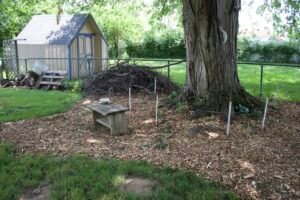
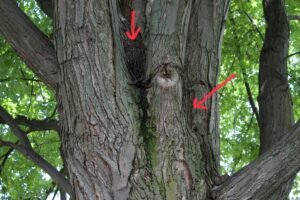
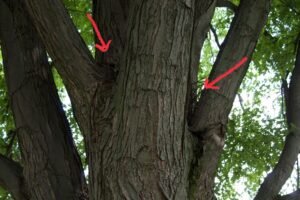
The oldest resident of this property is a Silver Maple (Acer saccharinum).
The tree is likely close to a century old, perhaps older.
Long before this house was built, the maple was already here.
Before many of the surrounding homes existed, it was already part of the landscape.
That tree has supported countless generations of wildlife.
Over the decades, squirrels have likely nested in its branches, robins have raised countless broods among its leaves, and migrating birds have paused there during their long journeys.
Exactly how many, I’ll never know.
But the questions themselves are a reminder that this place has a history far older than my own experience with it.
Today, the maple continues to support life in ways that aren’t always obvious. Birds nest in its branches, squirrels use it for food and shelter, insects feed among its leaves, and beneath its canopy, fallen leaves, decaying wood, and brush provide cover for countless smaller creatures.
What appears to be a single tree is actually a shared space used by many different species.
The maple isn’t just a tree.
It’s a community.
Who Really Owns a Habitat?
The more time I spend observing wildlife, the more I realize there may be multiple answers to that question.
Humans have developed ownership systems that help organize society. Property ownership provides structure, responsibility, and legal protections.
Wildlife operates under a different set of rules.
A squirrel’s claim to a habitat comes through use.
A robin’s claim comes through nesting.
A groundhog’s claim comes through generations of burrows and pathways.
A maple tree’s claim comes from supporting life for generations.
These forms of ownership aren’t legal.
They’re ecological.
One exists on paper.
The other exists through relationships.
Neither completely cancels the other out.
They simply describe the same landscape from different perspectives.
From Ownership to Stewardship
Perhaps that’s why I’ve become less interested in the idea of ownership or control and more interested in the idea of stewardship.
I don’t own the fox squirrels, robins, wrens, rabbits, or the groundhog.
I don’t even truly own the habitat itself.
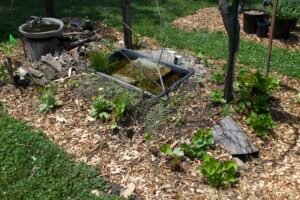
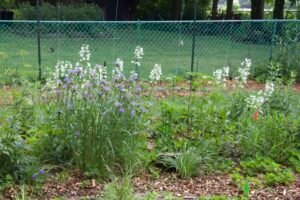
What I can do is make the space a little more welcoming by planting native species, providing water during dry periods, leaving natural areas undisturbed, and creating places where wildlife can find shelter.
Those actions don’t make the habitat mine.
They simply make me a participant in it.
A steward rather than an owner.
A Shared Landscape
Tomorrow morning, the fox squirrel will likely be back in the maple tree.
The wrens will continue defending their nest.
The robin will patrol the yard.
The rabbit will emerge to feed.
The goldfinches will visit flowers and seedheads.
None of them will acknowledge the property lines drawn on a map.
And that’s part of what I enjoy most about sharing space with wildlife.
They remind me that a habitat is more than a piece of real estate.
It’s a living community an ecosystem.
For a brief period of time, I happen to be one member of that community.
The squirrel doesn’t know who owns the property.
The robin doesn’t care.
The maple tree certainly isn’t concerned with legal documents.
Life simply continues around them.
Ownership has changed hands many times during the maple’s lifetime, yet the tree has remained a constant presence for the wildlife that depends on it.
Final Thought
In my 17 years of gardening, one of the biggest lessons I’ve learned is that nature responds when we choose to work with it rather than trying to control it.
I can’t control what happens in every neighboring yard, the field behind the property, or the larger landscape around me. What I can control is how I care for the small piece of the world entrusted to me.
By planting native species, leaving natural areas, creating shelter, and providing water during dry periods, I’ve watched wildlife gradually become part of the space. Some species stay year-round. Others stop by briefly before moving on.
The fox squirrel, wrens, robins, chipmunks, rabbits, snakes, insects, and countless other creatures don’t belong to me. They never will.
But sharing space with them has changed the way I think about a backyard.
What once felt like an eighth of an acre now feels like something much larger—a living community where every species plays a role.
And every evening, when I step outside and see that community going about its business, I’m reminded that the greatest reward of creating habitat isn’t ownership.
It’s participation.